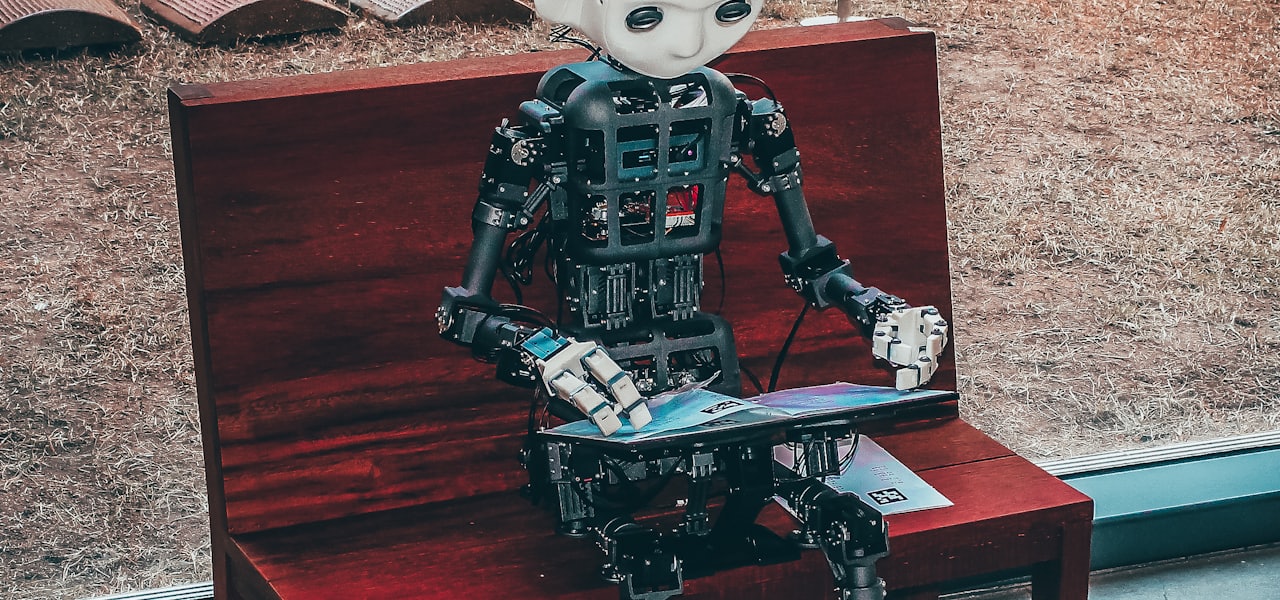
Albert One is an artificial intelligence chatbot created by Robby Garner and designed to mimic the way humans make conversations using a multi-faceted approach in natural language programming. == History == In both 1998 and 1999, Albert One won the Loebner Prize Contest, a competition between chatterbots. Some parts of Albert were deployed on the internet beginning in 1995, to gather information about what kinds of things people would say to a chatterbot. Another element of Albert One involved the building of a large database of human statements, and associated replies. This portion of the project was tested at the 1994-1997 Loebner Prize contests. Albert was the first of Robby Garner's multifaceted bots. The Albert One system was composed of several subsystems. Among those were a version of Eliza, the therapist, Elivs, another Eliza-like bot, and several other helper applications working together in a hierarchical arrangement. As a continuation of the stimulus-response library, various other database queries and assertions were tested to arrive at each of Albert's responses. Robby went on to develop networked examples of this kind of hierarchical "glue" at The Turing Hub.
AdTruth
AdTruth is a software product and the digital media division of 41st Parameter, a company headquartered in Scottsdale, Arizona, with regional offices in San Jose, California; London, England; and Munich, Germany. AdTruth allows marketers to recognize and reach target audiences across online devices. AdTruth software identifies users for targeting, tracking, performance tracking across digital media, including mobile and desktop, by analysing patterns in large numbers of advertisements served over the internet, rather than through the use of cookies. == History == AdTruth was founded in 2011 by Ori Eisen of 41st Parameter, to repurpose the company's fraud detection and prevention technology, for use within the advertising industry to accurately target intended audiences, particularly in mobile. Eisen was joined by James Lamberti in the role of vice president and general manager. In 2012 41st Parameter raised $13 million in Series D financing from Norwest Venture Partners, Kleiner Perkins Caufield & Byers, Jafco Ventures and Georgian Partners, bringing total funding to about $35 million. In May 2012, AdTruth hosted a meeting of digital media executives to discuss Apple’s UDID deprecation, with the intent of developing a device-neutral replacement standard. AdTruth joined the World Wide Web Consortium's Tracking Protection Working Group, which provides guidance for implementing and adhering to Do Not Track policies. AdTruth also worked with privacy firm Truste to create a privacy compliant Do Not Track-style mechanism for mobile. In 2013, the company Experian purchased 41st Parameter, acquiring AdTruth as part of the deal. == Product == AdTruth software helps marketers track, target and retarget consumers using more than 100 parameters, including milliseconds in differences in the internal clock setting, to recognize a particular device anonymously. AdTruth's technology uses non-UDID information to identify a wide range of devices for cookieless ad targeting. Its technology currently has about a 90 percent accuracy rate on iOS, higher on Android and desktop. AdTruth also has mobile web to app bridging capabilities as well as DeviceInsight technology, enabling marketers to identify users across mobile web and app content. 41st Parameter's patented AdTruth technology is being used by MdotM, in response to the deprecation of the UDID that included tracking and targeting capabilities. == Competitors == AdTruth's main competitor is BlueCava, which deploys a similar device-fingerprinting technology.
Site Security Handbook
The Site Security Handbook, RFC 2196, is a guide on setting computer security policies and procedures for sites that have systems on the Internet (however, the information provided should also be useful to sites not yet connected to the Internet). The guide lists issues and factors that a site must consider when setting their own policies. It makes a number of recommendations and provides discussions of relevant areas. This guide is only a framework for setting security policies and procedures. In order to have an effective set of policies and procedures, a site will have to make many decisions, gain agreement, and then communicate and implement these policies. The guide is a product of the IETF SSH working group, and was published in 1997, obsoleting the earlier RFC 1244 from 1991.
Lossless join decomposition
In database design, a lossless join decomposition is a decomposition of a relation r {\displaystyle r} into relations r 1 , r 2 {\displaystyle r_{1},r_{2}} such that a natural join of the two smaller relations yields back the original relation. This is central in removing redundancy safely from databases while preserving the original data. Lossless join can also be called non-additive. == Definition == A relation r {\displaystyle r} on schema R {\displaystyle R} decomposes losslessly onto schemas R 1 {\displaystyle R_{1}} and R 2 {\displaystyle R_{2}} if π R 1 ( r ) ⋈ π R 2 ( r ) = r {\displaystyle \pi _{R_{1}}(r)\bowtie \pi _{R_{2}}(r)=r} , that is r {\displaystyle r} is the natural join of its projections onto the smaller schemas. A pair ( R 1 , R 2 ) {\displaystyle (R_{1},R_{2})} is a lossless-join decomposition of R {\displaystyle R} or said to have a lossless join with respect to a set of functional dependencies F {\displaystyle F} if any relation r ( R ) {\displaystyle r(R)} that satisfies F {\displaystyle F} decomposes losslessly onto R 1 {\displaystyle R_{1}} and R 2 {\displaystyle R_{2}} . Decompositions into more than two schemas can be defined in the same way. == Criteria == A decomposition R = R 1 ∪ R 2 {\displaystyle R=R_{1}\cup R_{2}} has a lossless join with respect to F {\displaystyle F} if and only if the closure of R 1 ∩ R 2 {\displaystyle R_{1}\cap R_{2}} includes R 1 ∖ R 2 {\displaystyle R_{1}\setminus R_{2}} or R 2 ∖ R 1 {\displaystyle R_{2}\setminus R_{1}} . In other words, one of the following must hold: ( R 1 ∩ R 2 ) → ( R 1 ∖ R 2 ) ∈ F + {\displaystyle (R_{1}\cap R_{2})\to (R_{1}\setminus R_{2})\in F^{+}} ( R 1 ∩ R 2 ) → ( R 2 ∖ R 1 ) ∈ F + {\displaystyle (R_{1}\cap R_{2})\to (R_{2}\setminus R_{1})\in F^{+}} === Criteria for multiple sub-schemas === Multiple sub-schemas R 1 , R 2 , . . . , R n {\displaystyle R_{1},R_{2},...,R_{n}} have a lossless join if there is some way in which we can repeatedly perform lossless joins until all the schemas have been joined into a single schema. Once we have a new sub-schema made from a lossless join, we are not allowed to use any of its isolated sub-schema to join with any of the other schemas. For example, if we can do a lossless join on a pair of schemas R i , R j {\displaystyle R_{i},R_{j}} to form a new schema R i , j {\displaystyle R_{i,j}} , we use this new schema (rather than R i {\displaystyle R_{i}} or R j {\displaystyle R_{j}} ) to form a lossless join with another schema R k {\displaystyle R_{k}} (which may already be joined (e.g., R k , l {\displaystyle R_{k,l}} )). == Example == Let R = { A , B , C , D } {\displaystyle R=\{A,B,C,D\}} be the relation schema, with attributes A, B, C and D. Let F = { A → B C } {\displaystyle F=\{A\rightarrow BC\}} be the set of functional dependencies. Decomposition into R 1 = { A , B , C } {\displaystyle R_{1}=\{A,B,C\}} and R 2 = { A , D } {\displaystyle R_{2}=\{A,D\}} is lossless under F because R 1 ∩ R 2 = A {\displaystyle R_{1}\cap R_{2}=A} and we have a functional dependency A → B C {\displaystyle A\rightarrow BC} . In other words, we have proven that ( R 1 ∩ R 2 → R 1 ∖ R 2 ) ∈ F + {\displaystyle (R_{1}\cap R_{2}\rightarrow R_{1}\setminus R_{2})\in F^{+}} .
NHS COVID-19
NHS COVID-19 was a voluntary contact tracing app for monitoring the spread of the COVID-19 pandemic in England and Wales, in use from 24 September 2020 until 27 April 2023. It was available for Android and iOS smartphones, and could be used by anyone aged 16 or over. Two versions of the app were created. The first was commissioned by NHSX and developed by the Pivotal division of American software company VMware. A pilot deployment began in May 2020, but on 18 June development of the app was abandoned in favour of a second design using the Apple/Google Exposure Notification system. Scotland and Northern Ireland had separate contact tracing apps. A 2023 study estimated that in its first year of use, the app's contact tracing function prevented an estimated 1 million cases, and 9,600 deaths. == Description == The app allowed users to: See the alert level of their local authority area (in Wales) or information about restrictions (in England); to enable this, the user must enter the first half of their postcode "Check in" at places displaying an NHS QR code poster (no longer required by legislation after 26 January 2022, removed from the app the next month) Be notified when they have been in close contact with someone who has tested positive for the virus Be notified when local health protection teams determine that people with the virus had attended a business or other venue around the same time as the user Check their symptoms, and book a coronavirus test if necessary If asked to self-isolate, receive information and a daily "countdown". At first, "close contact" was defined as being within 2 metres for 15 minutes, or within 4 metres for a longer time. These time durations were reduced from 29 October 2020, to as little as three minutes when the other person is at their most infectious, i.e. soon after they begin showing symptoms. === Implementation === The Android app was coded in Kotlin, and the iOS app in Swift. The backend used Java and is deployed to Amazon Web Services using Terraform. The code of the app and back-end is open-source and available on GitHub. == Context == The app was part of the UK's test and trace programme which was chaired by Dido Harding; from 12 May 2020 Tom Riordan, chief executive of Leeds City Council, led the tracing effort. == First phase and cancellation == === Description === In March 2020, NHSX commissioned a contact tracing app to monitor the spread in the United Kingdom of the coronavirus disease 2019 (COVID-19) in the 2020 pandemic, developed by the Pivotal division of American software company VMware. The app used a centralised approach, in contrast to the Google / Apple contact tracing project. NHSX consulted ethicists and GCHQ's National Cyber Security Centre (NCSC) about the privacy aspects. The app recorded the make and model of the phone and asked the user for their postcode area. It generated a unique installation identification number and also a daily identification number. It then used Bluetooth Low Energy (BLE) to record the daily identification number of other users nearby. If a user was unwell, they could tell the app about symptoms which are characteristic of COVID-19, such as a fever and cough. These details were then passed to a central NHS server. This would assess the information and notify other users that have been in contact, giving them appropriate advice such as physical distancing. The NHS would also arrange for a swab test of the unwell user and the outcome would determine further notifications to contacts: if the test confirmed infection with COVID-19, the contacts would be asked to isolate. By June 2020, £11.8 million had been spent on the app; in 2020–21, £35 million was spent on the app. === Deployment === The first public trial of the app began on the Isle of Wight on 5 May 2020 and by 11 May it had been downloaded 55,000 times. When the first national contact tracing schemes were launched – Test, Trace, Protect in Wales on 13 May, then on 28 May NHS Test and Trace in England, and Test and Protect in Scotland – the app was not ready to be included. Replying to a question at the government's daily briefing on 8 June, Hancock was unable to give a date for rollout of the app in England, saying it would be brought in "when it's right to do so". On 17 June, Lord Bethell, junior minister for Innovation at the Department of Health and Social Care, said "we're seeking to get something going before the winter ... it isn't a priority for us at the moment". On 18 June, Health Secretary Matt Hancock announced development would switch to the Apple/Google system after admitting that Apple's restrictions on usage of Bluetooth prevented the app from working effectively. At the same press briefing Dido Harding, leader of the UK's test and trace programme, said "What we've done in really rigorously testing both our own Covid-19 app and the Google-Apple version is demonstrate that none of them are working sufficiently well enough to be actually reliable to determine whether any of us should self-isolate for two weeks [and] that's true across the world". === Concerns === The first, ultimately rejected, version of the app was subject to privacy concerns, the government backtracking on initial statements that the data collected from the app would not be shared outside the NHS. Matthew Gould, CEO of NHSX, the government department responsible for the app, said the data would be accessible to other organisations, but did not disclose which. Data collected would not necessarily be anonymised and would be held in a centralised repository. Over 150 of the UK's security and privacy experts warned the app's data could be used by 'a bad actor (state, private sector, or hacker)' to spy on citizens. Fears were discussed by the House of Commons' Human Rights Select Committee about plans for the app to record user location data. Parliament's Joint Committee on Human Rights said this version of the app should not be released without proper privacy protections. The second version of the app, released nationwide, addressed these concerns by employing a decentralised framework, the Apple/Google Exposure Notification system. Under this system, users remain pseudonymous: a person diagnosed with COVID-19 does not know which people are informed about an encounter, and contacted persons do not receive any information about the person diagnosed with COVID-19. The functionality of the app was also questioned in late April and early May 2020, as the software's use of Bluetooth required the app to be constantly running, meaning users could not use other apps or lock their device if the app was to function properly. The developers of the app were said to have found a way of working around this restriction. === Related contracts === Faculty – a company linked to Cambridge Analytica – provided research and modelling to NHSX in support of the response to the pandemic. Palantir, also linked to Cambridge Analytica, provided their data management platform. These contracts began in February and March respectively. == Second phase == As outlined on cancellation of the first app on 18 June 2020, the Department of Health and Social Care published on 30 July a brief description of the "next phase" app. Users would be able to scan a QR code at venues they visit, and later be notified if they had visited a place which was the source of a number of infections; the app would also assist with identifying symptoms and ordering a test. By using the Exposure Notification system from Apple and Google, personal data would be decentralised. Zuhlke Engineering Ltd, the UK branch of Swiss-based Zühlke Group, used 70 staff to complete the development of the app in 12 weeks. Zuhlke Engineering was awarded "Development Team of the Year" title at UK IT Industry awards in November 2021 for development of NHS COVID-19 application. === Timeline === Testing of the app by NHS volunteer responders, and selected residents of the Isle of Wight and the London Borough of Newham, began around 13 August. The app was made available to the public (aged 16 or over) in England and Wales on 24 September. An updated app released on 29 October, in part from collaboration with the Alan Turing Institute, improved the accuracy of measurements of the distance between the user's phone and other phones. At the same time, the duration threshold for determining exposure was reduced; this was expected to lead to an increase in the number of users told to self-isolate. An update to the app in April 2021, timed to coincide with easing of restrictions on hospitality businesses, was blocked by Apple and Google. It was intended that users who tested positive would be asked to share their history of visited venues, to assist in warning others, but this would have contravened assurances by Apple and Google that location data from devices would not be shared. === Statistics and effectiveness === The app was downloaded six million times on the first day it was generally availa
Automatic scorer
An automatic scorer is the computerized scoring system to keep track of scoring in ten-pin bowling. It was introduced en masse in bowling alleys in the 1970s and combined with mechanical pinsetters to detect overturned pins. By eliminating the need for manual score-keeping, these systems have introduced new bowlers into the game who otherwise would not participate because they had to count the score themselves, as many do not understand the mathematical formula involved in bowler scoring. At first, people were skeptical about whether a computer could keep an accurate score. In the twenty-first century, automatic scorers are used in most bowling centers around the world. The three manufacturers of these specialty computers have been Brunswick Bowling, AMF Bowling (later QubicaAMF), and RCA. == History == Automatic equipment is considered a cornerstone of the modern bowling center. The traditional bowling center of the early 20th century was advanced in automation when the pinsetter person ("pin boy"), who set back up by hand the bowled down pins, was replaced by a machine that automatically replaced the pins in their proper play positions. This machine came out in the 1950s. A detection system was developed from the pinsetter mechanism in the 1960s that could tell which pins had been knocked down, and that information could be transferred to a digital computer. Automatic electronic scoring was first conceived by Robert Reynolds, who was described by a newspaper story at the time as "a West Coast electronics calculator expert." He worked with the technical staff of Brunswick Bowling to develop it. The goal was realized in the late 1960s when a specialized computer was designed for the purpose of automatic scorekeeping for bowling. The field test for the automatic scorer took place at Village Lanes bowling center, Chicago in 1967. The scoring machine received approval for official use by the American Bowling Congress in August of that year. They were first used in national official league gaming on October 10, 1967. In November, Brunswick announced that they were accepting orders for the new digital computer, which cost around $3,000 per bowling lane. Bowling centers that installed these new automatic scoring devices in the 1970s charged a ten cents extra per line of scoring for the convenience. == Description == Each Automatic Scorer computer unit kept score for four lanes. It had two bowler identification panels serving two lanes each. The bowler pushed it into his named position when his turn came up so the computer knew who was bowling and score accordingly. After the bowler rolled the bowling ball down the lane and knocked down pins, the pinsetter detected which pins were down and relayed this information back to the computer for scoring. The result was then printed on a scoresheet and projected overhead onto a large screen for all to see. The Automatic Scorer digital computer was mathematically accurate, however the detection system at the pinsetter mechanism sometimes reported the wrong number of pins knocked down. The computer could be corrected manually for any errors in the system; similarly, human errors, such as neglecting to move the bowler identification mechanism, could be corrected for by manual action. The scorer could take into account bowlers' handicaps and could adjust for late-arriving bowlers. The automatic scorer is directly connected to the foul detection unit. As a result, foul line violations are automatically scored. Brunswick had put ten years of research and development into the Automatic Scorer, and by 1972 there were over 500 of these computers installed in bowling centers around the world. AMF Bowling, competitor to Brunswick, entered into the automatic scorer computer field during the 1970s and their systems were installed into their brand of bowling centers. By 1974, RCA was also making these computers for automatic scoring. == Reception and further developments == The purposes of the computerized scoring were to avoid errors by human scorers and to prevent cheating. It had the side benefit of speeding up the progress of the game and introducing new bowlers to the game. Score-keeping for bowling is based on a formula that many new to bowling were not familiar with and thought difficult to learn. These casual bowlers unfamiliar with the formula thought the scores given by the computers were confusing. Some bowlers were not comfortable with automatic scorers when they were introduced in the 1970s, so kept score using the traditional method on paper score sheets. The introduction of this device increased the popularity of the sport. Automatic scorers came to be considered a normal part of modern bowling installations worldwide, with owners and managers saying that bowlers expect such equipment to be present in bowling establishments and that business increased following their introduction. Brunswick introduced a color television style automatic scorer in 1983. Bowling center owners could use these style automatic scorers for advertising, management, videos, and live television. By the 2010s, these types of electronic visual displays could show bowler avatars and social media connections to publicize the bowlers' scores. Some are capable of being extended entertainment systems of games for children and adults. Some scoring systems support variations on traditional bowling, such as different kinds of bingo games where certain pins have to be knocked down at certain times or practice regimes where certain spares have to be accomplished. By this point, QubicaAMF Worldwide, an outgrowth of AMF, was one of the leading providers of bowling scoring equipment.
Psychology in cybersecurity
The psychology of cybersecurity (often intersecting with usable security and cyberpsychology) is an interdisciplinary field studying how human behavior, cognitive biases, and social dynamics influence information security. While traditional cybersecurity focuses on hardware and software vulnerabilities, this discipline addresses the "human factor," which is exploited in cyberattacks. Psychology in cybersecurity draws from cognitive psychology and human–computer interaction. == History and evolution == The challenge of human behavior in computing was noted as early as the 1960s with multi-user mainframes like the Compatible Time-Sharing System (CTSS). In 1966, a software error on CTSS caused the system's master password file to be displayed to every user upon login—one of the earliest documented security incidents attributable to a combination of system design and human factors. These behaviors gained broader significance in the 1990s as the Internet became widely accessible. High-profile incidents involving figures like Kevin Mitnick demonstrated how human trust could be exploited through social engineering such as pretexting over the phone. == Cognitive and behavioral factors == Much of the psychology of cybersecurity focuses on decision-making under stress or uncertainty. Researchers apply frameworks like dual process theory to explain why humans fall for phishing or business email compromise. Threat actors design malicious communications to trigger fast, emotional "System 1" thinking—using urgency, authority, or panic, which prompts users to click a link or wire funds before their analytical "System 2" can assess the situation's legitimacy. Industry research has consistently documented the effectiveness of these techniques at scale, pointing to several recurring psychological phenomena that influence daily security practices: Cognitive biases: The optimism bias leads users to believe they are unlikely to be targeted by cybercriminals, resulting in lax password practices or delayed software updates. The availability heuristic causes individuals to focus on highly publicized, sophisticated threats while ignoring common, statistically probable risks like credential reuse. Social influence: Attackers leverage established principles of persuasion, such as those categorized by Robert Cialdini. Impersonating a CEO leverages the psychological trigger of authority, while fake tech support scams use reciprocity (offering to fix a problem before asking for network credentials). == Neurological and pre-cognitive factors == Functional magnetic resonance imaging (fMRI) studies show that neural activation in visual and attentional regions decreases with repeated exposure to the same stimulus, a phenomenon termed repetition suppression. Experiments have confirmed this effect in the context of security warnings: static warning designs produce declines in user attention and adherence. Information processing research on phishing indicates that affective cues, such as artificial urgency or fear, increase cognitive load and elicit automatic heuristic processing, reducing the likelihood of analytical evaluation and facilitating compliance with malicious requests. == Security fatigue and organizational dynamics == Aggressive cybersecurity postures can sometimes lead to mental and emotional exhaustion, a phenomenon known as security fatigue. === Alert fatigue === One example is alert fatigue, which most frequently affects both end-users and security operations center analysts. Continuous exposure to browser warnings or antivirus pop-ups, particularly those that are false positives, conditions users to dismiss alerts automatically due to the volume of notifications rather than their repetitive appearance (see § Neurological and pre-cognitive factors). The scale of this problem is significant in enterprise: SOC teams in large organizations receive thousands of alerts daily, and a survey published in ACM Computer Surveys found that analysts spend over 25% of their time handling false positives, meaning that malicious indicators can be buried in the noise. === Password fatigue === Similarly, password fatigue is the feeling experienced by many people who are required to remember an excessive number of passwords as part of their daily routine, such as to log in to a computer at work. Users cope with the memory burden by making predictable, iterative changes to their passwords (such as updating "Password01!" to "Password02!"), which decreases password security.